GUEST POST on freespiritpublishingblog

Guest Post: Social Stories: An Individualized Learning Tool


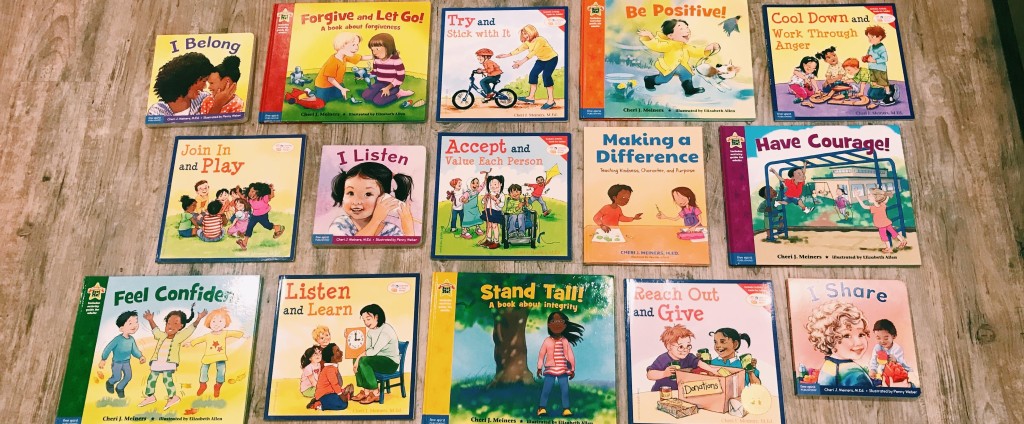
By Cheri J. Meiners, author of the Free Spirit Learning to Get Along® series
A friend once asked me for advice regarding her two-year-old child. She was concerned about her daughter’s biting and throwing tantrums. I offered to help her write a story for her daughter. Social stories are useful behavioral tools for teachers, counselors, and parents when working with any young child, and have particular benefits for children who struggle with communication and social skills.
True social stories—as defined and developed by Carol Gray, an author and consultant to students with autism spectrum disorders (ASD)—must include specific clinical criteria. But the stories themselves are short and simply worded, and your own stories can be patterned after these principles. Basically, a social story explains to a child behaviors or skills that can be useful in a social setting. Desired actions and outcomes are laid out in a logical step-by-step process. Through frequent readings of the story, a child can become more prepared for social interactions, routines, and situations.
To begin, you will want to observe the current behavior of the child, considering the factors that may be influencing it. Young children are often limited in their ability to communicate, express emotions, and understand social expectations, and may not acquire new behavioral skills spontaneously. That is why a clearly written social story that is easy for a young child to comprehend can be such a useful tool in learning about social expectations.
One of the first tips I gave my friend was to write her story from her child’s perspective—in the first person. This is an essential element of a good social story. Hearing the word “I,” a child can easily identify with, remember, and retain the instructional phrases.
A good introduction will start at the child’s current developmental level. Lay out the beginning situation or problem. My friend’s story might have started: “Sometimes I play with other children. If I don’t get my way, I may feel angry.”
In the body of the story, write almost every sentence as a positive, affirming statement. Some people suggest that you first discuss the undesired behavior, and then the desired behavior afterward. It is my preference to avoid writing about negative behavior altogether. In my mind, it can give the undesired behavior too much attention. My rule of thumb is to use only positive statements unless the problem behavior can hurt someone or damage property. My friend’s story was one of those times, so we may have included a directive, like, “I won’t bite or hit people.” We could then follow up with a simple explanation, such as, “Those things hurt. They won’t solve my problem.”
Throughout the rest of your little book, you will want to give instruction on the target skill. My friend’s story could talk about ways to calm down and feel in control again. The length and level of detail in your story will depend primarily on the child’s comprehension level, but always strive for an organized, succinct telling. Four types of sentences will typically be used in any social story:

§  Descriptive statements objectively describe the setting or situation. My books in the Learning to Get Along series—which use many concepts of the social story—actually incorporate few descriptive statements. I prefer brevity, relying on good illustrations to fill out the setting. You will typically want to have one statement and illustration for each page. An example from my friend’s story could be, “Sometimes I play with other children.”
§  Perspective statements include the feelings, thoughts, and opinions of the people in the story, such as, “I may feel angry.”
§  Directive statements are instructional. These statements are really the reason for the story. They tell the child what the desired behavior looks like. For example, “I can take deep breaths to help me calm down.”
§  Affirmative statements might reinforce things the child is already doing well, or they might encourage the child to try a new behavior. A child will identify with and be receptive to a story that is upbeat and empowering. End your story with an affirmation, such as, “When I talk about my problem, I may feel better.”
As mentioned earlier, it is recommended that your text be enriched with colorful, engaging illustrations that will add life to your script and make comprehension easier. Because young children are concrete thinkers, illustrations can help explain and solidify the message, as well as increase retention. When I write a handmade, individualized story, I like to use pictures from children’s magazines and workbooks, along with hand drawings. You might also use clip art that you find online. Each of the four statement types above can be enhanced with illustrations. Visual cues can help describe the setting; show the perspective and emotions of the characters through facial and body expressions; help directives appear more realistic and desirable; and affirm and reinforce the message.
Once the story is written, the fun part is to present it to the child. Plan to read the personalized story to the child in a calm setting. Reread it frequently—even daily, at first, to help the child become familiar with the concepts. Then the story can be used as a reference when a problem situation arises.


One of the central features of a social story is that it is tailored for a particular child. While my Learning to Get Along books are for general use and don’t use specifics like a child’s name, your own story can include specific names, pictures, and personal touches that the child recognizes.
For instance, for a handmade social story I wrote on “Friends and Strangers,” I collected random pictures of people from magazines as well as photographs of the child’s family and friends to illustrate the book and to use for a sorting activity afterward. In another instance, I personalized a story called “Everything in Its Place” by cutting out pictures of toys, clothes, and items that the child owned. The book pages had drawers, boxes, and doors that opened to hold the items to be put away.
Be creative and have fun writing your stories. Your child will likely treasure a unique story and ask for it to be read again and again. Maybe that’s because a social story is not only a great learning tool, but it provides a unique opportunity to encourage, motivate, bond, and build trust with the children in your life.

Please share any suggestions or experiences with writing social stories in the comments below.

Cheri J. Meiners, M.Ed., has her master’s degree in elementary education and gifted education. A former first-grade teacher, she has taught education classes at Utah State University and has supervised student teachers. Cheri and her husband, David, have six children and two grandchildren. They live in Laurel, Maryland.

Top 5 Children's Books


This article from Children's Books Guide includes 3 'Learning to Get Along' books.

Top 5 Children’s Books for Teaching Proper Behavior

words are not for hurtingWords Are Not for Hurting: Sticks and stones…we have all heard that and know that it’s not true. Words can hurt us, and this title helps children learn how powerful their words are. Words can have a big impact on those around us, whether positively or negatively. This excellent guide urges children to think before they speak and take responsibility for what they say. Also included are valuable lessons on facial expression, body language, dealing with serious problems, such as abuse, and the power of saying, “I’m sorry.” This is an excellent starting point for discussion and teaching kids behavior that respects everyone.
how to lose all your friendsHow to Lose All Your Friends: Have you ever had your child do the exact opposite of what you tell them? If so, then this collection of playful rules, or anti-rules, is perfect. Never smile. Don’t share. Whine. Cheat at cards. Be mean to your sibling. Each “rule” is accompanied by colorful illustrations and examples. If you follow all of these rules, it’s a great way to lose all your friends. Your child will see the undesirable consequences and be reminded that being nice is the best way to make and keep friends. A great guide for any contrary child!
the behavior survival guide for kidsThe Behavior Survival Guide for Kids: Few children’s books are as informative or full of empathy as this guide for kids with behavior disorders and learning disabilities. McIntyre writes for all the kids who say, “They think I’m slow or stupid, but I’m not,” or “They tease me.” He provides advice on coping with feelings, getting along with friends, family, and teachers, and dealing with people who are hard to get along with. Various scenarios are presented so children can think about what they would or should do. Concise text is mixed with cartoons to provide reinforcement and visual interest to help teach children behavior that is safe.
how to take the grrr out of angerHow to Take the Grrr Out of Anger: This award-winning guide tackles anger with clear text and fun cartoons to appeal to young readers. We all feel anger, but how do we deal with it? Managing anger is an important skill, and your child will learn tips and strategies to recognize and cope with this difficult emotion. This is a valuable resource for children and parents to use to develop healthy ways to deal with anger and resolve conflicts. You can effectively teach your kids behavior that is safe and appropriate and that will help him throughout life.
know and follow rulesKnow and Follow Rules: Why do we have rules? Why can’t we do whatever we want? Children often wonder this, and now there’s a perfect way to help them understand. This is a great guide for teaching your child rules because it simplifies them down to just four: listen, do your best work, keep your hands and body to yourself, and say please and thank you. Your child will have a good understanding of how to act in any situation by following these basic rules. Fun questions and activities help you reinforce the skills and follow up on them.


Other Great Children’s Books About Good Behavior

listen and learnListen and Learn: The Learning to Get Along series of children’s books focuses on different social skills, such as listening and sharing. Listening skills are crucial to doing well in school, at home, and in life. In this volume, a young boy explains what listening is and how to do it. We keep quiet, look at the person who is speaking, think about what they are saying, and ask questions if we need to. All of these are steps of active listening and will help your child improve his comprehension, school performance, and social adeptness. Bright pictures and familiar activities reinforce lessons.
if you had to choose, what would you doIf You Had to Choose, What Would You Do: This interactive collection of stories teaches children behavior that will help them make good decisions at home, at school, and in the community. Sandra McLeod Humphrey gives us 25 different stories with moral dilemmas and asks “What would you do?” Children learn best when they relate to the material, and these stories feature common things that kids come across in life. Thought-provoking dilemmas and follow-up questions provide excellent opportunities for discussion and role-playing. When your child is faced with a dilemma, this book will help him make choices that are safe, healthy, and smart.
time out for behaviorTime Out for Behavior: Sometimes you just need a time-out to think things through. This Mark J. Rolli picture book helps children do just that. Using a fun rhyme scheme and colorful illustrations, Rolli presents various rules for good behavior that apply to everyday life. One picture shows a little girl walking on the slippery side of a pool. The text reads, “Running, running fast I see. You should walk just like me.” Children will remember this couplet and others, making this an excellent book to teach kids behavior that is both safe and respectful. This is one time-out kids will enjoy.
talk and work it outTalk and Work It Out: The Learning to Get Along series discusses important issues of childhood: sharing, making friends, being polite, listening, and much more. This volume deals with solving problems by talking. Author Cheri J. Meiners provides invaluable tips and advice on conflict resolution – a skill that will be useful throughout your child’s life. How do you calm yourself? What exactly is the problem? How can you solve this? What do you do when you disagree about a solution? All of this and much more is included in this information-packed guide. Activities and role-playing activities are provided for extra reinforcement.
tails are not for pullingTails Are Not for Pulling: Whether you own pets or not, teaching children behavior that is safe and humane is essential. Often the first thing young children they do when the see a cat or dog is pull its tail or tug its fur. This is not only annoying, it’s potentially dangerous to the child. Can you scratch, pat, or cuddle an animal? Sure. Can you squeeze, hit, or taunt one? No. They also learn to read animal’s cues. Do they want to be touched or left alone? Children need very clear boundaries when it comes to animals, and this fun guide teaches them.

Check out this article at Children's Books Guide.

Review of Be Careful and Stay Safe

Be Careful and Stay Safe

be carefulI wrote this post before I heard about the horrific tragedy that occurred at the Newton School in Connecticut. My heart goes out to all of the victims and their families. Sometimes, even in the places that we view the “safest” for our kids, events like this occur that are unthinkable. My heart feels heavy for all of those affected by this massacre.
Mealtime is an ideal opportunity to discuss important topics with your children such as safety. I always discuss this topic with own children to help prepare them for situations that may not be safe. Be Careful and Stay Safe by Cheri J. Meiners is one of my favorite books within the collection of Learning to Get Along Series by Free Spirit Publishing. This book, which is geared towards readers 4 and up is an educational and resourceful book about staying safe and being careful in a variety of situations. Each page takes you through situations such as listening to grown ups when near electronic appliances such as a toaster, being aware of things that can hurt them (such as fire, knives, etc) and staying with your grown up when in the community. Take time to read this book to your children while they eat. They will absorb the material well which can lead to many important and interesting conversations. Ask lots of different “wh” questions such as “What would you do if a stranger talked to you?” and talk about how your child would feel in different situations (e.g. scared if they got lost). Role play and work on problem solving. Be Careful and Stay Safe also includes very helpful tips and carryover activities in the back of the book.

DECEMBER 7, 2012

Santa Ana first-graders learn the value of giving

Volunteers spread a love of reading and an ethic of volunteerism in young students in Santa Ana and across Orange County.

 
 listen-volunteer-remingto

By RON GONZALES / THE ORANGE COUNTY REGISTER

SANTA ANA – Twenty years from now, they might volunteer as the soccer coaches and PTA moms of Orange County.
On Friday morning, first-graders at Remington Elementary School learned about giving back to their neighborhood, community and school.

First-graders at Remington Elementary School in Santa Ana learned about giving back to their neighborhood, community and school. They did so through Spirit of Giving, organized by OneOC, which for more than a decade has sent volunteers to schools in low-income communities to inspire a love of reading and an ethic of volunteerism in young students.

Volunteers like Dianna Landucci, right, of Target, took part.  Like volunteers at other schools across Orange County, she read to them "Reach Out and Give," by Cheri J. Meiners, which focuses on giving and gratitude.  More than 1,000 first-graders at the 10 schools also got a free copy of "The Berenstain Bears Lend a Helping Hand," by Stan and Jan Berenstain.
 

Cool Down and Work Through Anger is ranked #26

Cool Down and Work Through Anger is currently ranked #26 in the category Juvenile Social Situations on the Nielsen BookScan Report for the week ending 09/23/12.  This is the 35th week it's been among the top 50 books in it's category.  It's gratifying to see that so many children are getting access to this book.

'Chaimommas' endorse the 'Learning to Get Along' series

The entire September 27, 2012 article by Neesha can be found at chaimommas.com

Learning to get along book series - Educating children about social situations and expectations

I came across a set of books that have made a huge difference in his understanding of getting along with others and building social skills.

It's called the Learning to Get Along Series by Cheri J. Meiners. The entire series covers almost every possible social situation your child can experience with other kids or even adults such as teachers, parents or family members. The books focus on decision making based on your social environment, which I think is critical for all kids to understand at a young age. It ranges from dealing with situations at school to being aware and making good choices in any social environment.

So what's so different about these books? At the end of each book, the author provides ways to reinforce what the book has explained and a set of games to play with your child to better understand the concepts. Some of these scenarios and games are a bit difficult for him at age two, but I can ask it in a different way where he will understand. He can grow into these books for the next few years.

I highly recommend these books for kids of all ages. The illustrations are great and the stories are very simple yet to the point.

Low-income O.C. kids get service lesson, free books


This exerpt is by:

Scott Martindale / THE ORANGE COUNTY REGISTER/ December 2, 2011

Thirteen high-poverty elementary schools participate in the annual Spirit of Giving service-learning project.

Though they may come from disadvantaged backgrounds, these kids are being taught to give back.
For the 11th consecutive year, about 1,750 first-graders at 13 high-poverty Orange County elementary schools received a lesson in service-learning Friday during the annual Spirit of Giving program sponsored by OneOC, formerly the Volunteer Center Orange County.

Article Tab: friday-ups-bryon-peters
First grade students listened as Bryon Anderson from UPS, read Friday morning in Mrs.Jeanine Kistner's class at Peters Elementary School in Garden Grove, as part of the Spirit of Giving experience organized by OneOC.
Volunteers visited dozens of first-grade classrooms Friday to read Cheri J. Meiners' "Reach Out and Give," a book intended to inspire youth to perform acts of kindness and service in their communities.

As part of the program, each first-grader also received two service-oriented books to take home.
The participating schools were:
Anaheim: Jefferson Elementary
Garden Grove: Woodbury Elementary, Iva Meairs Elementary, Peters Elementary
Huntington Beach: Oak View Elementary
Orange: Esplanade Elementary
Placentia: Melrose Elementary, Tynes Elementary (participated Thursday)
Santa Ana: Davis Elementary, Fairhaven Elementary, Hoover Elementary, Remington Elementary
Westminster: Finley Elementary
Contact the writer: 949-454-7394 or smartindale@ocregister.com


Kindergarten Readiness with 'Listen and Learn'

Helping children to develop readiness for school is goal of both parents and schools.  A national education goal states that "all children will enter school ready to learn".  Howard County Maryland has a such a program entitled 'Ready at 5'.

 As part of this program, all children in the county are now being issued my book Listen and Listen to prepare them with readiness skills.  Listen and Learn helps children understand the different parts of good listening, and why it's important.  Learning to listen is the first academic skill children need in order to learn.  Good listening helps children focus and absorb the other lessons taught in school.  It is also vital to developing communication, social skills and friendships at school.

New Review by Textbooks.org

Read the great new review of the 'Learning to Get Along' series at Textbooks.org 

Book Series Review: Learning to Get Along by Cheri J. Meiners

by Greg on August 16, 2012
 
How many times in your life have you had trouble getting along with someone else? It happens to everyone. It might be you or it might be the other person who is causing this back-and-forth struggle. People of all ages experience this, and perhaps it happens more often with younger individuals who are not as well-versed on solving conflicts in order to get along with everyone as much as possible.

Cheri J. Meiners wrote a series of 15 children’s books called “Learning to Get Along.” This book series is designed to help young children learn, understand, and practice some of the most basic skills for social situations and emotional dilemmas. The books contain a number of concrete examples of common conflicts that people experience in their lives every day. The books also discuss diversity and how person is unique. These books can be used in a daycare environment, in schools that offer pre-K or kindergarten classes, or at home so that parents can read them with their children. They are designed to be read aloud as well to help reinforce the messages in them. Each book focuses on one specific skill and concludes with some concrete ideas so that young readers will walk away with something to remember.

The first book in the series, titled Share and Take Turns, was published in March 2003 by Free Spirit Publishing. As the book’s title suggests, this book explores the practice of sharing by presenting children with specific examples and illustrations that might come up during their childhood and later in life as an adult. It helps kids understand the importance of sharing, how and why people should share, and what the benefits of this practice are to everyone involved.

The other books in the series include:
- Accept and Value Each Person
- Be Careful and Stay Safe
- Be Honest and Tell the Truth
- Be Polite and Kind
- Cool Down and Work Through Anger
- Join In and Play
- Know and Follow Rules
- Listen and Learn
- Reach Out and Give
- Respect and Take Care of Things
- Talk and Work It Out
- Try and Stick with It
- Understand and Care
- When I Feel Afraid

The series has received several awards and nominations. These include the ‘Carol D. Reiser Children’s Book Award in 2008, a finalist for the Teacher’s Choice Award for Learning Magazine in 2006, and a nomination as one of the top 5 series on the Character Education Series booklist in 2005.
Meiners, the author of the series, has a Master’s degree in Elementary and Gifted Education from Utah State University. She is a world traveler and has taught at many educational levels, from first grade up to the college level. For more information on her and the book series, visit www.cherijmeiners.com.

Review of Know and Follow Rules

Here's a review of Know and Follow Rules by blogger Robyn Campbell. 


Know and Follow Rules Written by: Cheri J. Meiners M.ED. Free Spirit Publishing (March 31, 2005)

Suitable for:
Ages 4 and up
 
Theme:
Following the rules
 
Opening:
We have rules for play. . .
And we have rules for work.
Sometimes we work quietly.
 
Synopsis:
A child who can’t follow rules is a child who’s always in trouble. This book starts with simple reasons why we have rules: to help us stay safe, learn, be fair, and get along. Then it presents just four basic rules: “Listen,” “Best Work,” “Hands and Body to Myself,” and “Please and Thank You.” The focus throughout is on the positive sense of pride that comes with learning to follow rules. Includes questions and activities adults can use to reinforce the ideas and skills being taught.
 
Why I loved it:
This sweet book is worded so simply, even the younger picture book kidlets can grasp the meaning. It focuses on how much the children can take pride in following the rules. Includes questions and activities adults can use to reinforce the ideas and skills being taught.
 

New Posters


Posters are now available for four books in the series: Share and Take Turns, Listen and Learn, Know and follow Rules and Cool Down and Work Through Anger.  These are great reminders and conversation starters for kids at school and at home.

Series published in Chinese

All 15 books in the 'Learning to Get Along' series have been published by a Chinese publisher, Xi'an Rongxin CDC,  into simplified Chinese.

Radio Interview with Writer's Voice

Cheri was a radio guest of Francesca Rheannon of Writer's Voice which aired October 20th, 2011.  You can click on the title to go to Writer's Voice to hear the podcast.  Under the bio you'll find the podcast player.  You can forward to 42:30 to go directly to her interview.

BOOKS THAT REFERENCE THIS SERIES

  • Building A Culture Of Literacy Month-By-Month by Hilarie B. Davis and Larry Ross
  • Creating Inclusive Learning Environments for Young Children: What to Do on Monday Morning by Clarissa Ann Willis
  • Great Preschools: Building Developmental Assets in Early Childhood by Tamara J. Will, Karen King, and Michelle Mergler
  • I Can Play It Safe by Alison Feigh and Laura Logan
  • Jeff Herman's Guide to Book Publishers, Editors & Literary Agents 2007) by Jeff Herman
  • Learn More Now: 10 Simple Steps to Learning Better, Smarter, and Faster by Marcia L. Conner
  • On Those Runaway Days by Alison Feigh and Laura Logan
  • Parent To Child—The Guide: How To Create A Comprehensive And Meaningful Journal To Prepare Your Child For Life by Natalie D'Annibale Bandlow
  • Reaching Out, Joining in: Teaching Social Skills to Young Children With Autism (Topics in Autism) by Mary Jane Weiss and Sandra L. Harris
  • Ready for Bed!: A Tale of Cleaning Up, Tucking In, and Hardly Any Complaining (ParentSmart/KidHappy Series) by Stacey R. Kaye and Elizabeth O. Dulemba
  • Ready for Preschool: Prepare Your Child for Happiness and Success at School by Nancy Hertzog Ph.D.
  • Ready for the Day!: A Tale of Teamwork and Toast, and Hardly Any Foot-dragging (Parentsmart/Kidhappy Series) by Stacey R. Kaye and Elizabeth O. Dulemba
  • Ready to Rock Kids Volume 2 by Dr. Mac & Friends
  • Ready to Rock Kids: Song, Activities, and a Lot of Fun for Kids Ages 4-9 by Dr. Mac and Debbie M. O'Neal
  • Safe & Caring Schools Grades 1-2: Hundreds of Ways to Improve Classroom Climate and Achieve Academic Success by Katia S. Petersen and Ph.D
  • Safe & Caring Schools Preschool-Kindergarten: Hundreds of Ways to Improve Classroom Climate and Achieve Academic Success by Katia S. Petersen and Ph.D.
  • Safe and Caring Schools: A Social/ Emotional Resource Guide to Improve Acadamic Success and School Climate, Grades Pre K-2 by Ph. D. Katia Petersen
  • Teaching Kids With Mental Health and Learning Disorders in the Regular Classroom: How to Recognize, Understand, and Help Challenged (And Challenging) Students Succeed by Myles L. Cooley (Paperback - April 2007)
  • The 6 Most Important Decisions You'll Ever Make: A Teen Guide to Using the 7 Habits by Sean Covey
  • The Hidden Gifts of the Introverted Child: Helping Your Child Thrive in an Extroverted World by Marti Olsen Laney
  • The Special Needs Ministry Handbook: A Church's Guide to Reaching Children with Disabilities and Their Families by Amy Rapada
  • Twin Sense: A Sanity-Saving Guide to Raising Twins -- From Pregnancy Through the First Year by Dagmara Scalise

OTHER BOOKS YOU MAY ENJOY

The Power of Positive Parenting : A Wonderful Way to Raise Children by Glenn I. Latham